AI Game Art and Copyright: The Lawsuits and Rulings Every Dev Should Actually Know
If you're shipping a game with AI-generated art, the copyright situation is messier than the "is AI art legal?" Reddit threads make it sound. There are two separate questions tangled together, and most devs conflate them. One: can the stuff you generated be copyrighted by you? Two: did generating it infringe on someone else's work? Those have different answers, different cases, and different stakes for a small studio.
I've been pulling AI video into 2D sprite pipelines for a while now, and I keep getting asked which lawsuit I'm scared of. Honest answer: none of them individually, but the pattern across all of them tells you exactly where the floor is. Here's the actual state of the case law as of mid-2026, with names and dates, and what it means when you drop an AI-made sprite sheet into your build.
Your AI-generated art probably isn't copyrightable on its own
This is the settled part, and it's settled hard. The US Copyright Office has refused registration for purely AI-generated images more than once, and the courts have backed them up.
Start with Thaler v. Perlmutter. Stephen Thaler tried to register an image called "A Recent Entrance to Paradise," generated autonomously by his own AI system, with the machine listed as the sole author. The Office refused. The D.C. district court upheld it in 2023, the D.C. Circuit affirmed in 2025, and on March 2, 2026 the Supreme Court denied certiorari — meaning the human-authorship requirement stands and the highest court declined to touch it. Works generated with no meaningful human creative contribution don't get a copyright. Full stop.
Then there's Théâtre D'opéra Spatial, the Midjourney piece that won a Colorado State Fair art prize. Jason Allen said he revised his prompt 624 times before landing the final image, then did some editing. The Copyright Office still refused registration in September 2023, saying the AI contributed more than a de minimis amount and that prompt iteration alone isn't authorship. Allen sued (Allen v. Perlmutter) and as of late 2025 was still fighting it on summary judgment. Don't bet your studio on him winning.
The Office also pulled back part of its registration for the comic Zarya of the Dawn in 2023 — the human-written text and the selection and arrangement of panels stayed protected, but the Midjourney-generated images were carved out.
In January 2025 the Copyright Office published Part 2 of its big "Copyright and Artificial Intelligence" report, and it basically codified all of this. Prompts, no matter how detailed, don't currently give you enough control over the expressive output to count as authorship. The Office left the door cracked — it acknowledged a future where prompt systems give "sufficient control" — but that future isn't now.
What actually does get protected
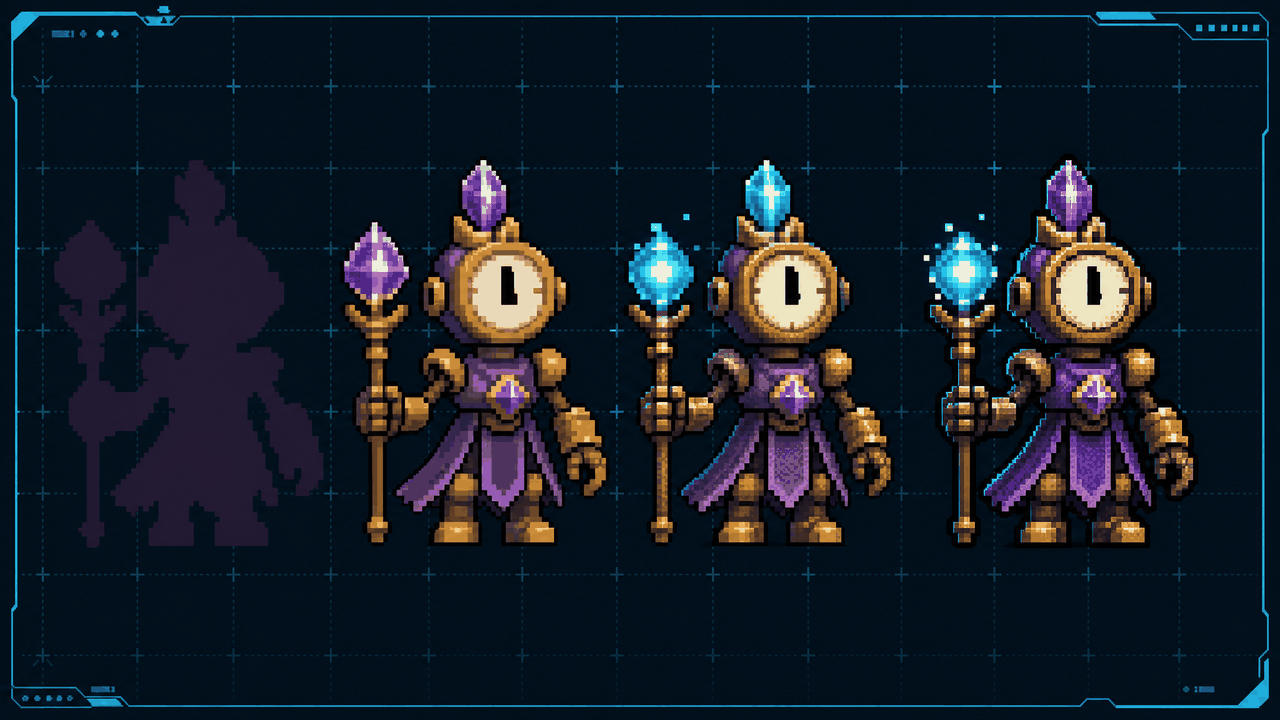
Here's the part devs miss because it's buried in the legalese: the arrangement and the human edits can be protected even when the raw generation isn't. In late January 2025 (its registration is dated January 30, 2025) the Copyright Office accepted a registration for an image called "A Single Piece of American Cheese," made with the AI tool Invoke. The difference was that the artist's specific, human-authored manipulation and selection were visible in the output and claimed as the protectable contribution, not the generation itself.
For a game, that maps cleanly onto how you should be working anyway:
- A single raw AI frame, untouched? Probably not yours to copyright.
- A sprite you generated, then hand-cleaned, recolored, re-timed, and arranged into an animation and a sheet? The human creative layer on top is protectable, and so is your overall game as a compilation.
- Your code, your level design, your story, your UI — all fully yours, AI art or not.
So the practical takeaway isn't "AI art means no copyright." It's that the more real editing you do on top of the generation, the more of your work is defensible. Pulling AI video into frames and then actually cleaning and timing them in a tool like the Sprite Frame Extractor is exactly the kind of human contribution that moves you from "uncopyrightable" toward "compilation with protectable human authorship." Keep your source files and edit history. If anyone ever questions it, that record is your evidence.
The infringement question is the one that's still live
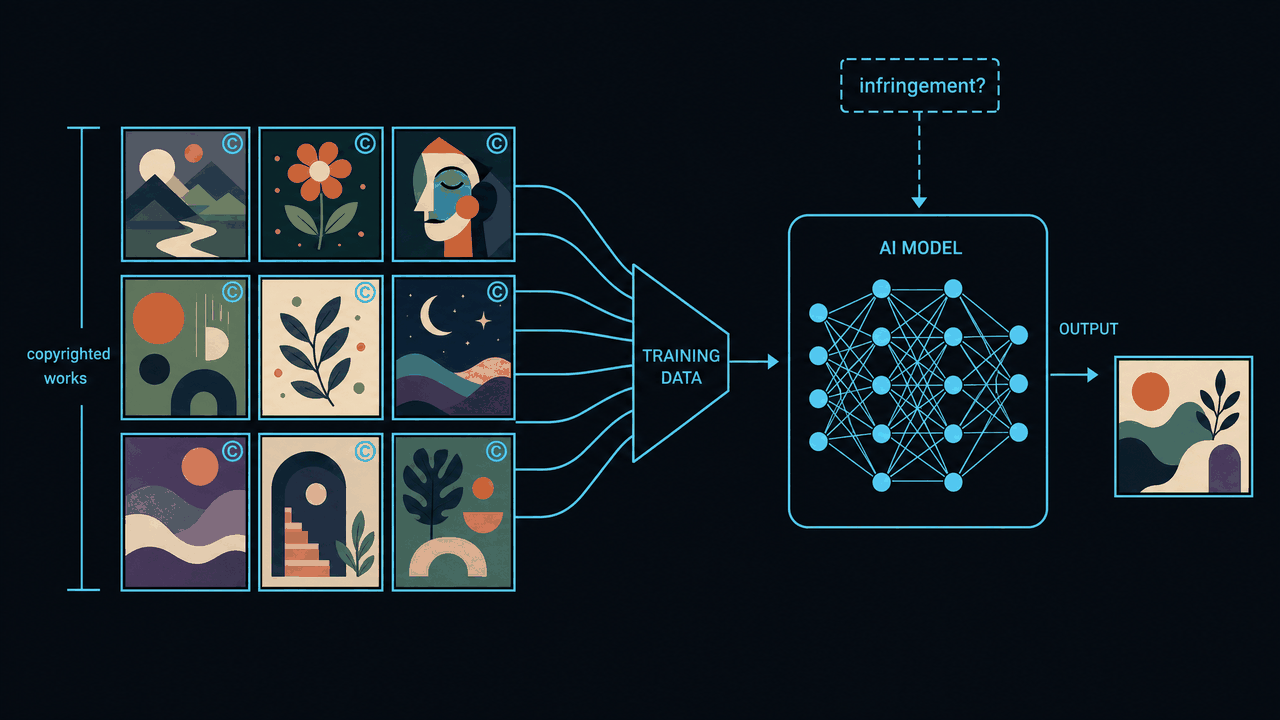
The scarier lawsuits aren't about whether you can register your sprite. They're about whether the model that made it was trained on copyrighted art without permission, and whether the outputs reproduce protected work.
Andersen v. Stability AI is the one to watch. Filed in early 2023 by artists Sarah Andersen, Kelly McKernan, and Karla Ortiz against Stability AI, Midjourney, and DeviantArt in the Northern District of California. Judge William Orrick has let the core copyright infringement claims survive multiple rounds of dismissal motions. In his August 2024 decision the direct infringement and inducement claims went forward into discovery, while the DMCA copyright-management-information claims were dismissed for lack of evidence of identical outputs. As of mid-2026 the case is in discovery with trial reportedly set for September 2026. No verdict yet — this is the case that may actually answer whether training on scraped art is infringement.
Getty Images v. Stability AI already gave us a partial answer, and it's a weird one. The UK High Court ruled on November 4, 2025. Getty lost its secondary copyright infringement claim, but largely because Getty conceded the training didn't happen in the UK, so the court never decided the central question of whether training on copyrighted images is itself infringement. Getty did win narrow trademark findings on early Stable Diffusion versions that reproduced its watermark. Treat this as "AI developers dodged a bullet on a technicality," not "training is legal." The separate US Getty case — voluntarily dismissed in Delaware and refiled in the Northern District of California in August 2025 — is still pending.
And then the big one for anyone making game characters: Disney and Universal v. Midjourney, filed June 11, 2025 in the Central District of California, with NBCUniversal and DreamWorks also as plaintiffs. The studios' 110-page complaint shows Midjourney spitting out Bart Simpson, Shrek, Wall-E, Ariel, the Minions, and Star Wars characters on simple prompts. They're seeking an injunction that could force Midjourney to add output filters or shut down parts of its service. Midjourney has moved to dismiss.
What this means when you ship AI sprites
None of these cases has put a small dev on the hook for using a generation tool. The defendants are the AI companies, not their users. But the Disney case in particular is a flashing warning sign about what you prompt for and what comes out.
The hard line: do not generate characters that resemble existing copyrighted or trademarked IP. The training-data fight is the model maker's legal problem. A sprite of something that's recognizably a famous game mascot, a movie character, or a well-known cartoon princess is your legal problem the moment it's in your build, no AI required. That's just ordinary infringement with extra steps, and "the AI made it" is not a defense.
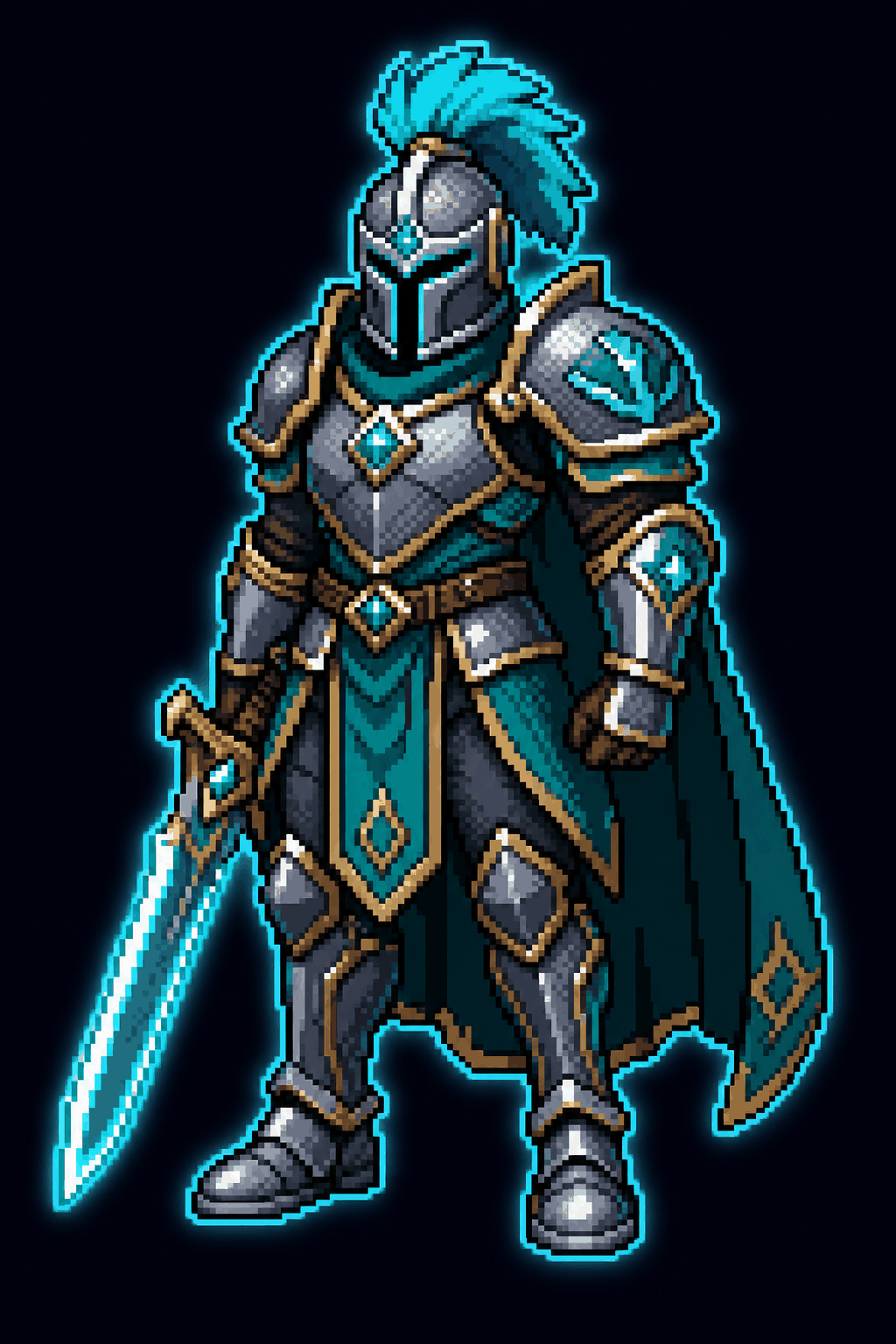
Practical rules I'd give any indie shipping AI-assisted art:
- Generate original characters, not lookalikes. If a frame comes out resembling a known property, throw it away. This is where most real risk lives, and it's entirely within your control.
- Edit meaningfully, and keep the receipts. Hand-cleanup, recoloring, retiming, and arrangement strengthen both your copyright claim and your "this is original work" position. Save layered files and version history.
- Read your tool's commercial terms. Veo, Sora, Kling, Runway, Midjourney, and the rest each have their own license and indemnity language, and it changes often. Some grant commercial use; some carve out exceptions. Know what yours actually says before you ship.
- Mind your platform's rules. Steam requires you to disclose AI use in your store page, and the disclosure terms have shifted. Check the current policy before launch, not after.
- Don't assume your generated art is exclusively yours. Because raw outputs may not be copyrightable, someone else could legally produce something similar. The protection comes from your human layer and your game as a whole, not the generation.
The honest summary for 2026: you can build a game with AI-assisted art and be on solid ground, but only if you treat the generator as a starting point and not a finished asset, and only if you never let it hand you someone else's character. The law is still moving — Andersen could change the calculus next year — so keep an eye on it. But the floor is already clear enough to work on.
FAQ
Q. Can I copyright art an AI generated for my game?
Not the raw output on its own. The US Copyright Office and the courts (Thaler v. Perlmutter, affirmed when the Supreme Court denied cert in March 2026) require human authorship. But your meaningful human edits, the selection and arrangement of frames, and your game as a whole compilation can be protected. The Office granted registration to 'A Single Piece of American Cheese' in late January 2025 precisely because the human-authored editing was the claimed contribution. Edit your AI sprites substantially and keep your source files.
Q. Will I get sued for using Midjourney, Runway, or Sora to make sprites?
The current lawsuits (Andersen v. Stability AI, Getty v. Stability AI, Disney and Universal v. Midjourney) target the AI companies over training data, not their individual users. Your real exposure is different: if you generate and ship a character that resembles existing copyrighted or trademarked IP, that's ordinary infringement and it's on you, not the tool. Generate original characters, never lookalikes.
Q. Did anyone win the AI art copyright lawsuits yet?
No final verdict on the core training question as of mid-2026. Andersen v. Stability AI is in discovery with trial reportedly set for September 2026. The UK Getty v. Stability AI ruling (November 4, 2025) went against Getty on copyright, but only because Getty conceded the training happened outside the UK, so the court never decided whether training on copyrighted art is infringement. Disney and Universal v. Midjourney, filed June 2025, is still early. The law is genuinely unsettled.
Q. Does training data being copyrighted mean my AI sprites are illegal to use?
That's the open legal question the courts haven't answered. No ruling has made it illegal for a developer to use outputs from a commercial AI tool. The training-data fight is between rights holders and the AI companies. Protect yourself by checking your tool's commercial license terms, avoiding outputs that mimic known IP, and disclosing AI use where platforms like Steam require it.
Sources
- https://copyrightalliance.org/andersen-v-stability-ai-copyright-case/
- https://www.bakerlaw.com/andersen-v-stability-ai/
- https://www.ropesgray.com/en/insights/viewpoints/102lvxe/getty-image-loses-copyright-infringement-claim-against-stability-ai-in-uks-first
- https://www.twobirds.com/en/insights/2025/uk/stability-ai-defeats-getty-images-copyright-claims-in-first-of-its-kind-dispute-before-the-high-cour
- https://www.cnbc.com/2025/06/11/disney-universal-midjourney-ai-copyright.html
- https://www.law.georgetown.edu/tech-institute/research-insights/insights/disney-nbc-universal-and-dreamworks-file-major-ip-lawsuit-against-ai-image-generator-midjourney/
- https://www.copyright.gov/ai/Copyright-and-Artificial-Intelligence-Part-2-Copyrightability-Report.pdf
- https://www.mintz.com/insights-center/viewpoints/54731/2025-02-07-us-copyright-office-publishes-second-part-report-ai
- https://www.copyright.gov/rulings-filings/review-board/docs/Theatre-Dopera-Spatial.pdf
- https://www.mayerbrown.com/en/insights/publications/2026/03/supreme-court-denies-review-in-ai-authorship-case
- https://www.finnegan.com/en/insights/ip-updates/supreme-court-declines-to-hear-thaler-v-perlmutter-leaving-human-authorship-requirement-intact.html
- https://journals.law.harvard.edu/jsel/2025/03/u-s-copyright-office-grants-registration-to-ai-generated-artwork/